Was Osaka Castle Damaged In WWII?
The 1945 air raids over Osaka Castle: what was actually targeted, what burned, what survived, and how the repairs shaped the castle visitors see today.
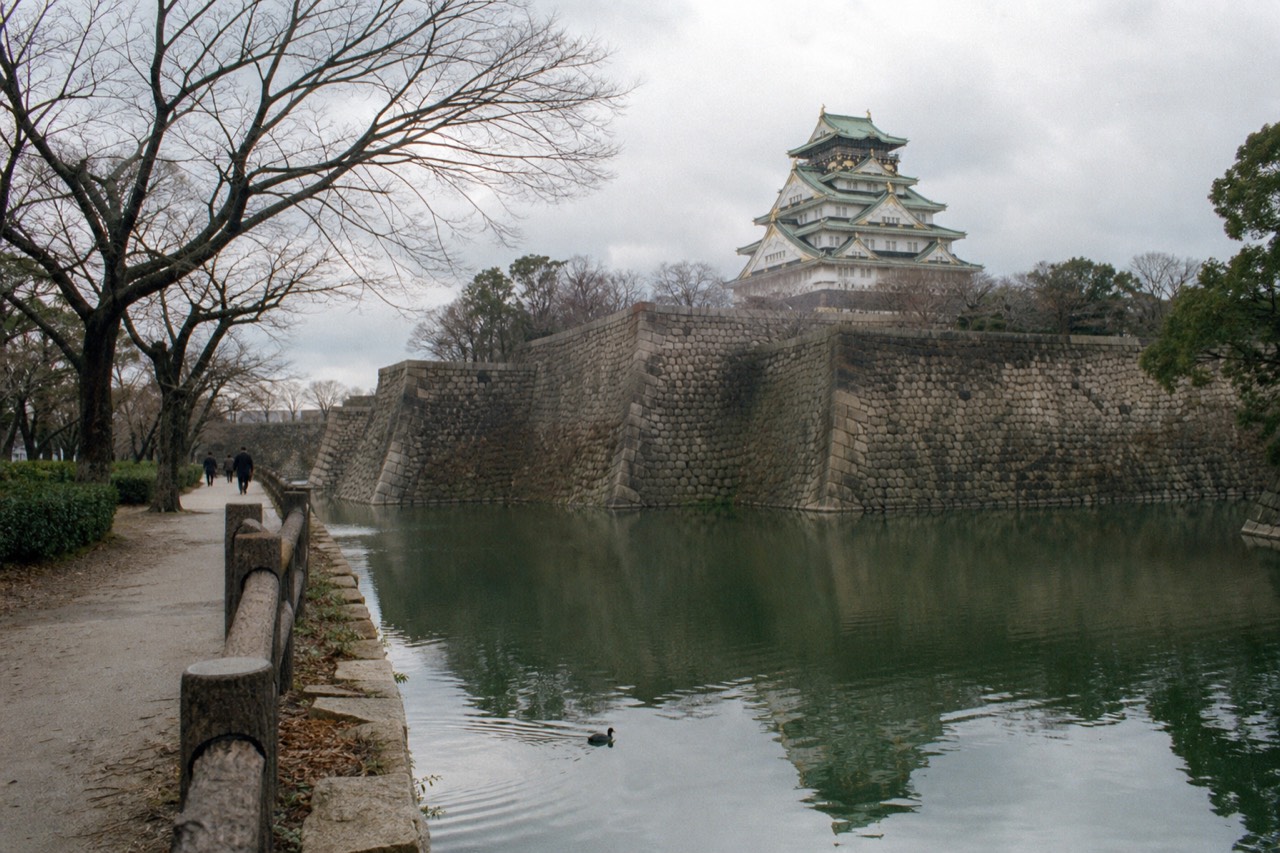
Was Osaka Castle Damaged In WWII?
Yes. American air raids in 1945 destroyed several castle buildings and damaged the stone base of the Main Tower, most severely on 14 August 1945, the day before Japan announced its surrender. The tower structure itself survived, thanks to how it had been rebuilt in 1931, and it has stood through every year since.
The damage was real, but it was narrower than most visitors assume. Osaka Castle Park in 1945 was not a quiet monument: it sat beside one of the largest arms factories in Japan, and that factory complex drew the bombers. The raids destroyed a number of buildings across the castle grounds, and one bomb that landed close to the Main Tower deformed the great stone platform it stands on.
The remarkable part is what did not happen. The tower you photograph today is the 1931 ferro-concrete reconstruction, and it was deliberately engineered so that its weight would not bear on the historic stone platform, called the tenshudai. That engineering decision, made for preservation reasons sixteen years before the war, is the reason a near-miss did not bring the tower down.
If you are planning to walk the grounds and see the walls for yourself, the castle's entry e-ticket and a guided walk are the two ways in:
The two are different products that stack rather than substitute, which matters for wartime history in particular. Admission covers the Main Tower, an eight-floor museum since the day it reopened, and the Osaka Castle Toyotomi Stone Wall Museum, an underground gallery that opened on 1 April 2025 beside the buried Toyotomi-era walls. A guided walk, by contrast, puts a live English-speaking guide on the grounds for 1.5 to 3 hours, and its base price does not include tower admission, a distinction worth knowing before you book either.
What Was The Actual Target Of The 1945 Air Raids?
The primary target was the Osaka Army Arsenal, an enormous weapons-manufacturing complex that stood immediately east of the castle grounds. The castle itself was not the aim of the bombing, but the arsenal and the castle park were effectively one continuous stretch of land, so fire, blast and stray bombs reached the castle anyway.
Osaka in 1945 was an industrial city with military production woven through its centre, and the arsenal was among the most important of those plants. Its workforce ran to tens of thousands at its peak, and its furnaces, machine shops and munitions stores sprawled across the district now largely occupied by Osaka Castle Park's eastern edge and the commercial land beyond it.
The park itself had also been reshaped by the war effort before a single bomb fell. Green space had been given over to cultivation and wartime use, as happened across Japanese cities, and the castle buildings stood inside a working industrial landscape rather than the ornamental park a visitor today would recognise.
That geography explains the pattern of the damage. The raids gutted the arsenal district, and the destruction spread into the park's edges and up to the tenshudai itself. The park's official history text records the consequences plainly: the Pacific War air raids destroyed several buildings and damaged the castle, with the heaviest raid falling on 14 August 1945, the day before the surrender. The castle museum's own site carries the same account.
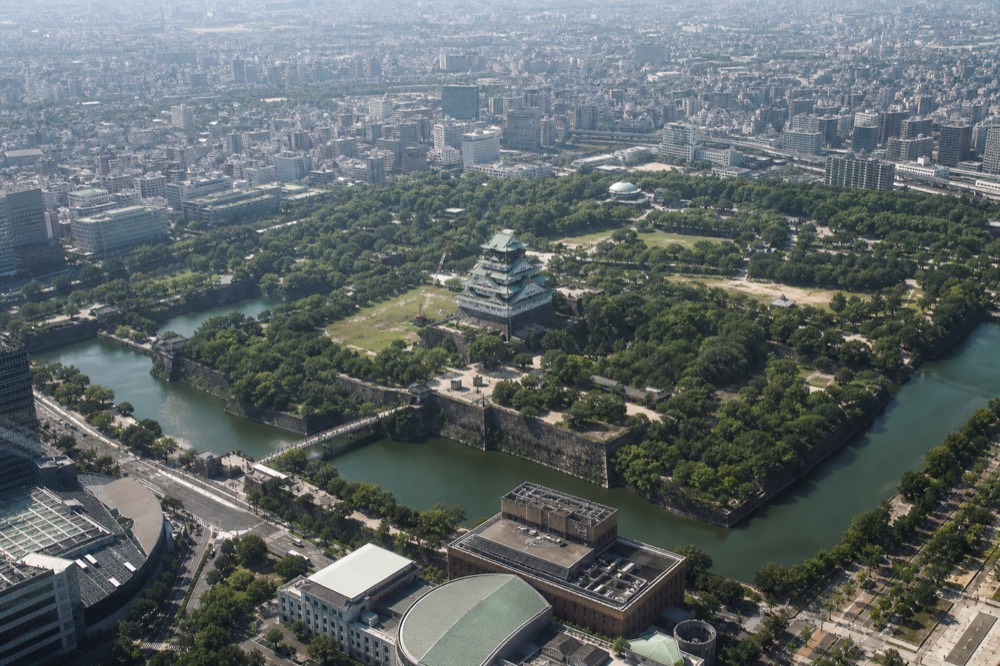
Wondering how to get inside the tower and judge the survival story for yourself? Admission to the Main Tower is ¥1,200 for adults, about $7.69, sold as an e-ticket with QR entry, no fixed time slot, and a voucher valid 30 days.
What Did The Bombs Do To The Main Tower?
A bomb landing a few metres north of the Main Tower on 14 August 1945 produced a visible slippage in the tenshudai stone wall, running from the north face around to the east face. The tower above it was unaffected, and corrective work to stop the distortion progressing was carried out in 1964, in Japan's Showa 39.
The tenshudai is the massive tiered stone platform on which every generation of the castle's tower has stood, and it dates from the Tokugawa rebuild of the 1620s. A bomb a few metres away was never going to leave it untouched. The shock shifted the great fitted stones, and the movement showed as a visible distortion in the wall face that wrapped from north to east.
The tower's survival came down to structural intent. When Osaka's citizens funded the 1931 reconstruction by public subscription, on the proposal of the then mayor Seki Hajime, the engineers designed the new ferro-concrete tower so that it would not load the historic tenshudai. The concrete structure carried itself, and the stone platform beneath kept its original role as a historic artefact rather than a foundation taking new weight.
That separation is why a near-miss that deformed the platform left the building above intact. The same official history records that the 1931 tower was unaffected, and that the distortion was stopped from progressing by corrective work completed in Showa 39, that is, 1964. The slippage in the tenshudai stone wall from its north face round to its east face remains visible to a visitor who looks for it, one of the quietest and most direct pieces of wartime evidence anywhere in the park.
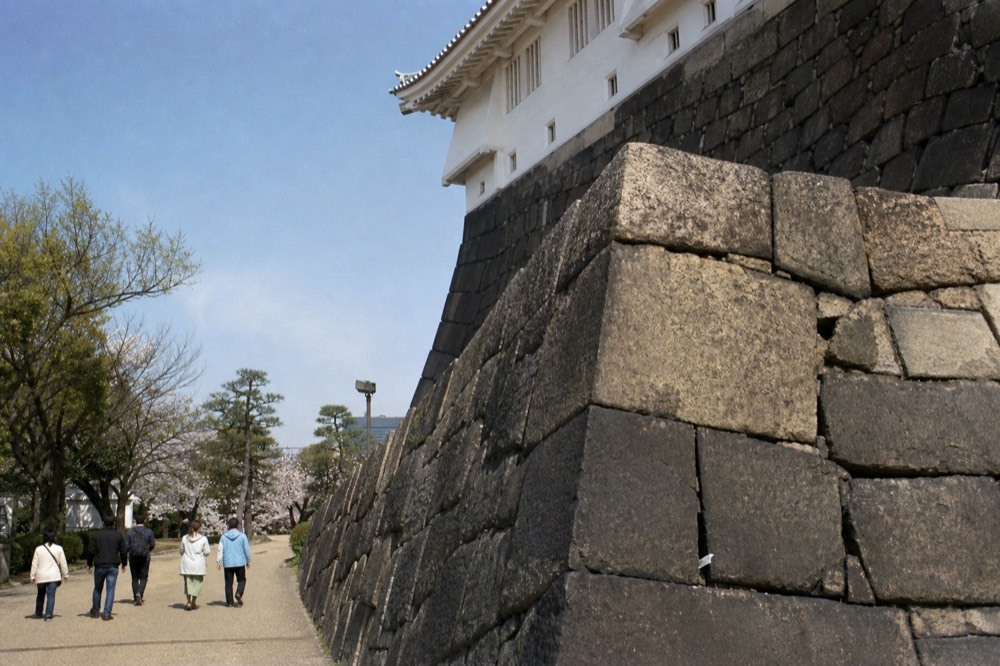
It is not the only mark the twentieth century left on these walls. Stone walls can move for reasons other than bombs, and the city keeps watching them: according to an Osaka City document, a capstone roughly 2 m long came off the inner-moat wall in May 2025, officials inspected the section on 29 May and 6 June 2025, and repairs were scheduled for March 2026. The city's inspection report gives the detail. That is ordinary maintenance on 400-year-old masonry, not a warning about stability, and it sits alongside the wartime slippage as part of the same story of a wall that is constantly, carefully conserved.
Which Castle Buildings Survived The War?
The Main Tower survived, along with the Otemon gate, the Tamon-yagura turret and the other structures that had been restored or spared across the park's history. Several other buildings were destroyed in the air raids, and the losses were severe enough that the postwar restoration programme ran from 1958 to 1966, rebuilding yagura and storehouses one by one.
The buildings that stood when the war ended were the ones that had already made it through the nineteenth century. The Meiji Restoration turmoil of 1868 burned most of the remaining castle structures, sparing only parts such as the Otemon and the Tamon-yagura, so the 1945 raids struck a grounds already reduced to its toughest survivors, plus the 1931 tower.
The postwar repair record is documented on the castle's own official pages, and it splits cleanly:
| Structure | Status through WWII | What happened next |
|---|---|---|
| Main Tower (1931 reconstruction) | Survived, tenshudai damaged | Remained standing; slippage corrected in 1964 |
| Otemon gate | Survived | Designated an Important Cultural Property in 1953 |
| Tamon-yagura turret | Survived | Designated 1953; restored in the postwar programme |
| Other yagura and storehouses | Some destroyed in the raids | Rebuilt and restored 1958 to 1966 |
| Osaka Army Arsenal (beside the park) | Destroyed | Site cleared; land became park and civic space |
Thirteen structures in the park, including the Otemon, the Tamon-yagura, the Sengan-yagura, the Inui-yagura, the Ensho-gura powder magazine and the Kinmeisui well house, were designated Important Cultural Properties in 1953, while the postwar restoration of the yagura and storehouses ran from Showa 33 to 41, that is, 1958 to 1966. The whole area was then developed as the public park, with the Osaka-jo Hall opening in 1983.
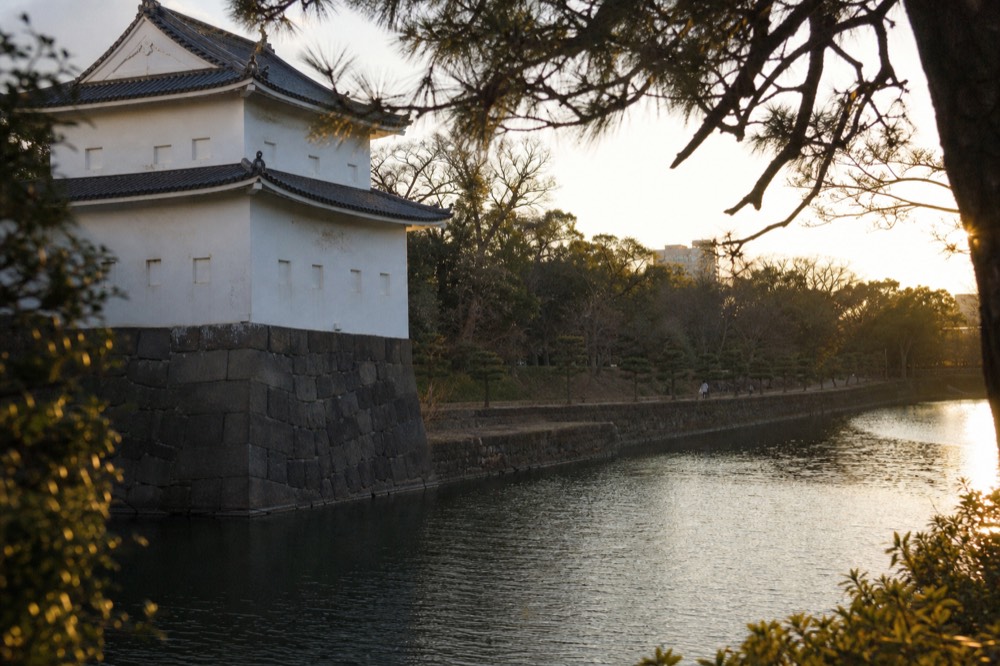
The turret you are looking at in that photograph is a survivor twice over, or a faithful postwar restoration of one. If you want to walk the grounds with someone who can tell you which is which, a guided walking tour is the practical way to do it: a live English-speaking guide, private or small group, 1.5 to 3 hours across the castle grounds, from $28.85. The tour's base price does not include tower admission, so a visit inside the tower needs a separate ticket.
How Was The Castle Repaired After The War?
Restoration proceeded in two waves. First, from 1958 to 1966, the destroyed yagura and storehouses were rebuilt and the grounds were developed into the public park. Then, in 1997, the Heisei Great Repair restored the Main Tower to its 1931 appearance, completing the postwar conservation of the castle that visitors see standing today.
The postwar programme treated the castle as a civic asset to be recovered rather than a ruin to be cleared. The yagura restorations of 1958 to 1966 returned the silhouette of the Tokugawa-era fortifications around the honmaru, and the park grew up around them: 105.6 hectares in total, formally opened in its current form on land that includes the former arsenal district, with about 3,000 cherry trees now standing where factories and barracks stood in 1945.
The 1997 Heisei Great Repair was the capstone. Half a century of weathering on the 1931 concrete tower was addressed and the building was restored to its original 1931 appearance, the same white walls and green-gold roof details you see from the moat today. That same year the tower was registered as a National Registered Tangible Cultural Property, recognition that a 1931 reconstruction could itself become heritage.
from $7.69 The from-price you see online and the price at the castle window are the same adult admission, so booking ahead costs nothing extra.
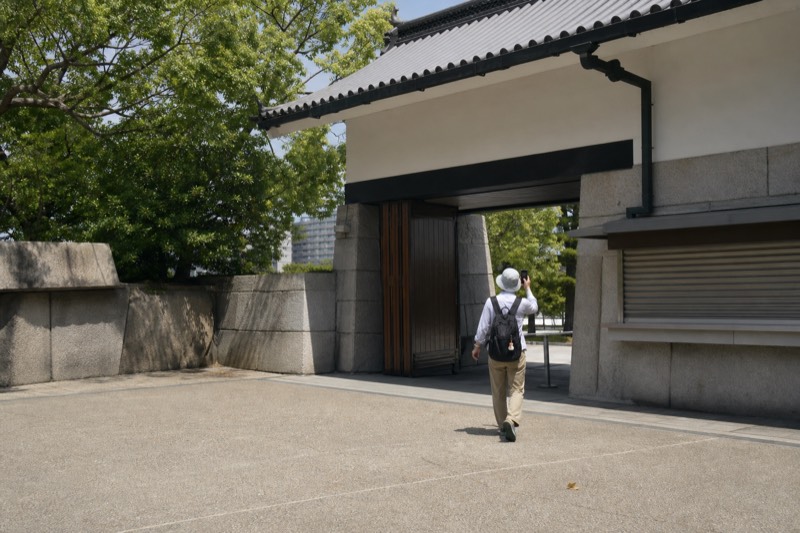
Your ticket into the tower
Official E-Ticket
- Osaka Castle Main Tower entry
- Osaka Castle Toyotomi Stone Wall Museum
- QR code entry
- Valid 30 days
- No fixed time slot
- No viewing time limit
Buying the official e-ticket ahead saves you the ticket-purchase line, not money, since the online price matches the window. You exchange nothing at the gate, you simply show the voucher and go in.
The real flexibility here is the voucher's 30-day validity, with no fixed time slot and no set viewing time limit.
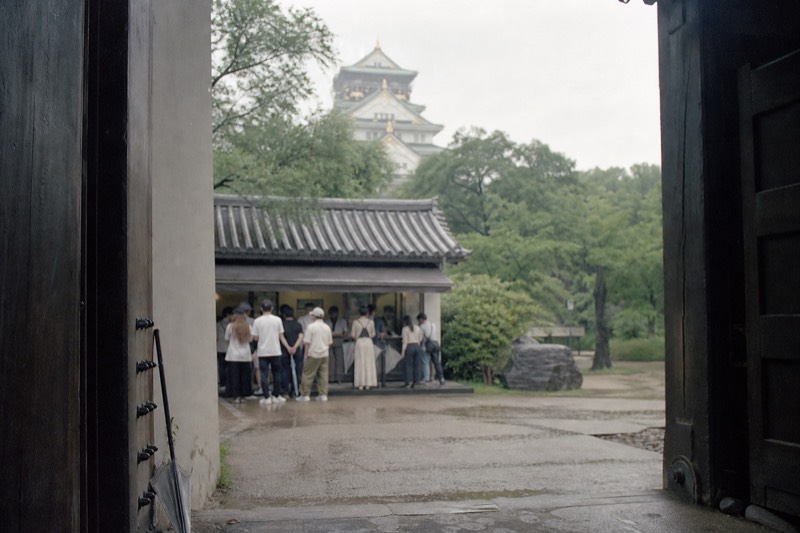
At The Gate
Adult, per person Group rate from 15 paying visitors Free categories at the window
¥1,200
The window price is identical to the online price, so nothing is lost by paying in person. Students and under-15s should buy here, because proof-of-age discounts are handled face to face and not through an e-ticket.
Students with ID and visitors aged under 15, since discounted and free rates are only applied at the window.
See what it covers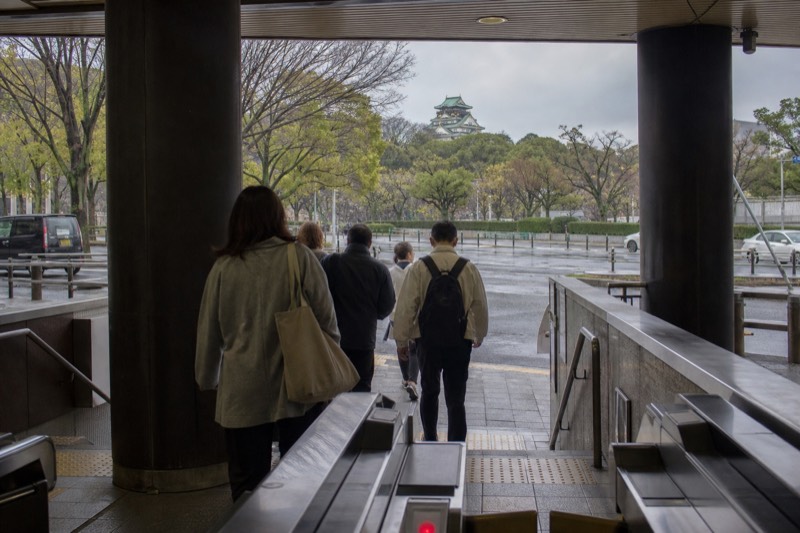
Osaka Amazing Pass
One-day pass On sale 25 March 2026 to 31 March 2027
¥3,500
The one-day pass costs 3,500 yen against the 1,200 yen castle ticket on its own, so it only pays off with two or more other paid sights. Add transport and the maths tips further in its favor.
Visitors packing several paid sights plus metro and bus rides into one day, who will clear the pass price easily.
See what it covers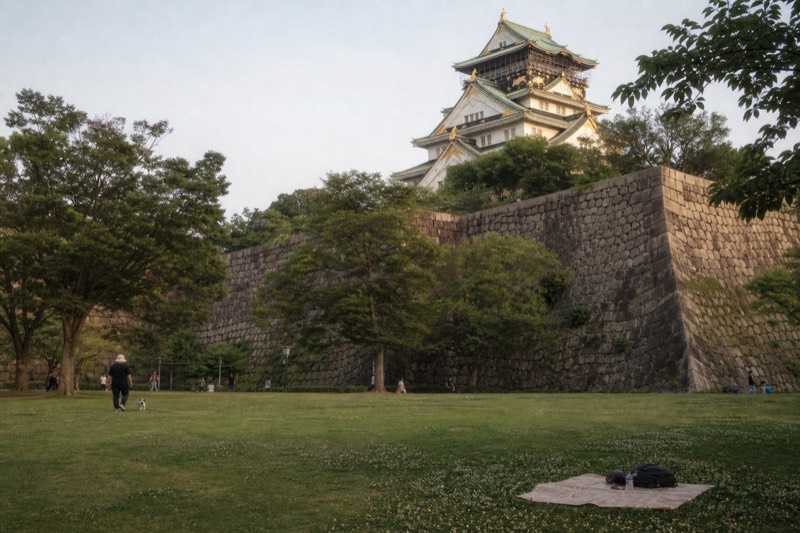
Free Park Areas
No admission charge
Free
The park grounds, moats, stone ramparts and exterior views of the tower cost nothing at all, and they fill a half day on their own. The paid line falls only at the Main Tower entrance and the Toyotomi Stone Wall Museum.
Anyone who wants the castle views, moats and grounds without paying to go inside the buildings.
See what it coversRecognition has kept coming. On 10 July 2025 the 1931 Main Tower was designated an Osaka City Tangible Cultural Property, announced through the castle's own news channel, and the castle marked the 94th anniversary of the 1931 reconstruction on 7 November 2025 with commemorative certificates and special lighting, per Osaka City's own announcement. A structure once nearly lost to a wartime near-miss is now protected at every level of the Japanese heritage system.
Is The Castle You See Today The Original?
No part of the visible tower predates 1931, and nothing above ground is older than the Tokugawa rebuild of the 1620s. The wartime story is one chapter in a longer chain: Hideyoshi's castle fell in 1615, the Tokugawa tower burned in 1665, the Meiji fires took most of the rest in 1868, and the 1945 raids completed the destruction.
That chain is the honest answer to the question visitors usually ask while standing on the 8F observation deck, about 50 m above the grounds. The castle has been damaged, destroyed and rebuilt so many times that the 1945 raids were not even the worst episode. The Summer War of Osaka in 1615 burned Hideyoshi's entire castle, and the Tokugawa shogunate then buried what remained under metres of fill and built its own, taller tower on top. That second tower burned in a lightning strike in 1665 and was never rebuilt, leaving the castle without a tenshu for over two and a half centuries.
The deeper layers survived all of it. The Toyotomi-era stone walls still exist underground, buried under about 6 m of fill at the nakanodan tier, and since 1 April 2025 you can walk down to a section of them in the Osaka Castle Toyotomi Stone Wall Museum, included in the ¥1,200 tower admission with no separate fee. It is the one place in the castle where the layer Hideyoshi actually built is visible, and it opened as part of the same conservation tradition that repaired the wartime damage.
If the rebuild chain is what drew you here, the longer version of that story, including why the 1931 tower looks the way it does, is told in how many times the castle was rebuilt, and the 1615 destruction that started it all is covered in who destroyed Osaka Castle.
What Can You See Today Of The Wartime Story?
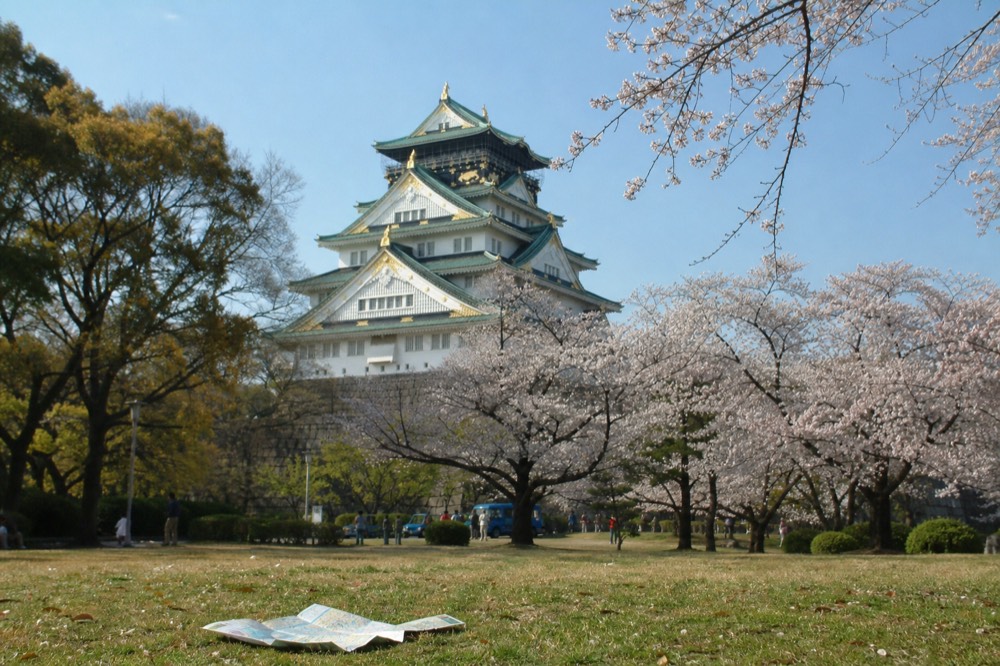
The visible evidence on site is the tenshudai slippage on the north and east faces of the tower's stone base, plus the park layout itself, which grew over the cleared arsenal land. Inside the tower, the museum's exhibitions tell the castle's full history, including the twentieth century, and the free audio guides in four languages walk you through it.
Start at the stone. Stand north or east of the tower and look at the base course of the tenshudai: the visible distortion from the 14 August 1945 near-miss is the single most direct piece of wartime evidence in the park, unmarked by any dramatic signage, and all the more striking for it. The 1964 corrective work stabilised it; the wall was never reset to perfect alignment.
Then read the ground. The park's sheer size, 105.6 hectares of green in the middle of a dense city, exists partly because the arsenal land was cleared after the war and folded into civic space. A visitor picnicking under the cherry trees on the eastern lawns is sitting on the footprint of the target the bombers came for.
Inside, the tower's exhibitions cover the castle's whole history, from Hideyoshi's foundation in 1583 through the 1931 reconstruction, and the 1F theater room, renewed in March 2025, screens programmes with Japanese, English, Chinese and Korean subtitles. Audio guides are lent free in Japanese, English, Korean and Chinese from the information counters on 1F and 5F, with reception from 9:00 to 17:00 and return by 17:30. Photography is banned on floors 3F and 4F, where the Important Cultural Properties are displayed, and free elsewhere, including the 8F observation deck.
For the practical side of getting in, the entry e-ticket is the straightforward route: QR entry, from $7.69 per adult, the same price as the official ¥1,200 gate rate with no markup. What it buys is a skipped ticket-purchase line and guaranteed entry, not a discount, and the voucher is valid 30 days with no fixed time slot. Students should note the gate sells rates the e-ticket does not: high school and university students pay ¥600 with proof, and junior high age and under enter free, so those visitors should simply buy at the gate.
Admission covers both the Main Tower and the Toyotomi Stone Wall Museum, same visit, and the whole thing is best seen early: hours run 9:00 to 18:00 with last admission at 17:30, closed only 28 December to 1 January, and the castle's own guide page warns the ticket queue may be capped before 17:30 on busy days. Visitors rate the experience 4.5 across 3,768 reviews, and the record FY2025 attendance, 2,813,851 admissions, provisional, tells you the crowds are part of the current reality. More on planning around that is in the site's guide to the castle's history and the coverage of whether the castle is worth it.
Whether you arrive on a quiet February morning or a golden-week afternoon, the building you walk into is a survivor with a paper trail: bombed near-missed in 1945, corrected in 1964, restored in 1997, designated in 2025, and visited now in record numbers. The team behind Osaka Castle Tickets keeps the practical side of getting inside up to date, so the wartime story is one you can check for yourself.
The two ways in, one more time, for the decision you are actually making:
The short answers: yes, the 1945 raids damaged the castle grounds and the tower's stone base but left the 1931 tower standing; the arsenal beside the park, not the castle, was the target; the destroyed buildings were rebuilt between 1958 and 1966; and the visible wartime scar on the tenshudai can still be seen today on the north and east faces of the tower's base.
Common Questions About Osaka Castle And WWII
Was Osaka Castle Damaged In WWII?
Yes. The 1945 air raids destroyed several buildings in the castle grounds and damaged the stone base of the Main Tower, most heavily on 14 August 1945. The 1931 tower structure itself survived because it was built not to load its stone platform, and the slippage in that platform was corrected in 1964.
Was The Main Tower Destroyed In The War?
No. The 1931 ferro-concrete tower survived the raids. A bomb landing a few metres north of it on 14 August 1945 deformed the tenshudai stone wall from the north face round to the east face, but the tower above was unaffected and corrective work on the wall was completed in 1964.
Why Was Osaka Castle Bombed At All?
The target was the Osaka Army Arsenal, the vast weapons complex immediately east of the castle grounds, not the castle itself. The arsenal and the park formed one continuous stretch of land, so destruction spread into the grounds and up to the tenshudai.
Which Castle Buildings Survived The War?
The Main Tower, the Otemon gate, the Tamon-yagura and several other historic structures survived. Several other buildings were destroyed, and the postwar restoration programme rebuilt the yagura and storehouses between 1958 and 1966.
Is The Current Tower Old?
The visible tower dates from 1931, when it was rebuilt by public subscription. Nothing above ground predates the Tokugawa rebuild of the 1620s. The tower was restored to its 1931 appearance in the 1997 Heisei Great Repair and designated an Osaka City Tangible Cultural Property on 10 July 2025.
Can You Still See Evidence Of The Wartime Damage?
Yes. The slippage in the tenshudai stone wall on the north and east faces of the tower's base remains visible. The park's eastern lawns also occupy the cleared former arsenal land, and the tower's museum exhibitions cover the twentieth-century history, with free audio guides in Japanese, English, Korean and Chinese.